
Every feature, and
what each one will not do
Every part of the program, including the parts most software would leave off a sales page. Each one says plainly where it stops being reliable - because a numismatic tool that over-promises costs its owner money, not time.
Capture
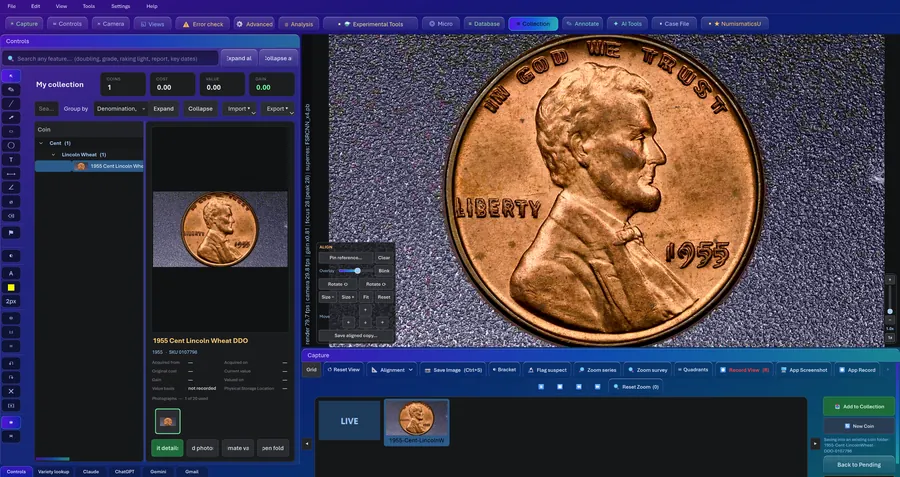
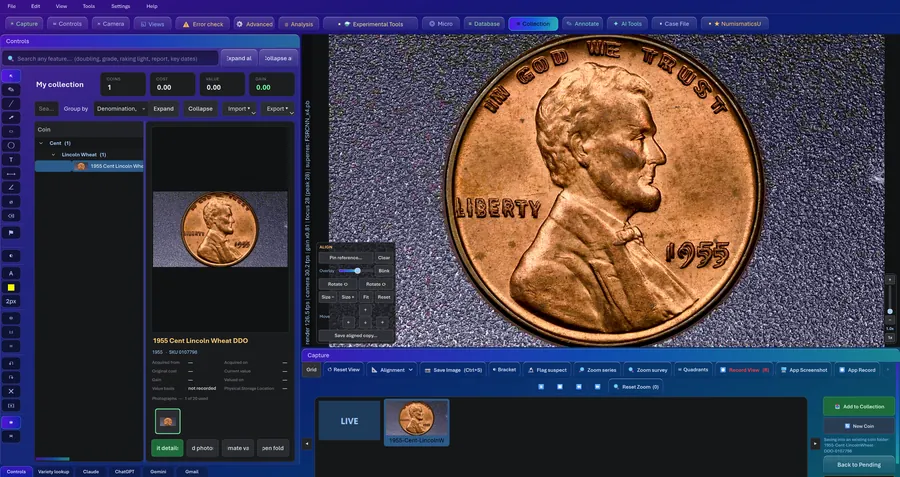
A live view from any USB microscope or webcam, with the things you actually need while framing a coin: focus peaking so you can see the plane of focus rather than guess at it, a live histogram so you know before you press the shutter whether the lustre is blown out, and a focus meter that tells you when you have hit the sharpest point of the knob's travel.
Shots go into the coin's own folder, named so a set reads as a set even in Explorer. A zoom series steps through magnifications; a quadrant sweep walks the coin in a grid so nothing is missed. Every photograph is written to a temporary name, flushed to disk, then renamed into place, so a crash cannot leave you with a half-written file under a real name.
A hundred photographs can be held against one coin, because a zoom survey and a quadrant sweep together run to dozens of frames before anybody has photographed a variety marker.


Cameras, phones and tethering
A USB microscope is really a webcam, and almost every control such a thing appears to offer is the software adjusting the picture afterwards rather than the sensor doing anything different. So NumismaLab also talks to the cameras that do have real controls: a DSLR or mirrorless body over USB, with nothing for you to install.
Your phone can be the camera too. A QR code puts its live feed into the program over your own Wi-Fi - no virtual-camera driver, no app to sideload - and you can frame and shoot from it. Because browsers only hand a page the live camera on a secure origin, the program runs a small HTTPS server with its own certificate to make that possible.
If you would rather shoot the way you already do, point the folder watcher at wherever your camera software drops its files. Every photograph that appears is filed into the open coin, raw files included.

Focus and detail stacking
At the magnifications a coin deserves, depth of field is measured in fractions of a millimetre, so the rim and the devices cannot both be sharp in one frame. Turn the focus knob slowly and the focus stack keeps, for every pixel, whichever frame was sharpest there - one photograph, sharp across the whole relief.
The detail stack answers a different problem. It aligns each incoming frame to a reference by phase correlation and keeps a running average, so sensor noise falls away and genuinely fine detail resolves - the lucky-imaging trick astronomers use, applied to a coin at high digital zoom.

Raw developer and Image Lab
A JPEG has already had every decision made for it - exposure moved to look pleasant, white balance guessed, highlights clipped, sharpening applied. On a coin the clipped highlight was the lustre. The raw developer opens the sensor's own numbers and lets you make those decisions yourself.
Image Lab is a stack of non-destructive steps applied in order to a copy, with the original never touched. That matters more here than in ordinary photo editing, because a coin photograph is often evidence: it gets measured, compared against a reference, and looked at again months later, and it has to still be the thing that was measured.


Fifteen ways to see the surface
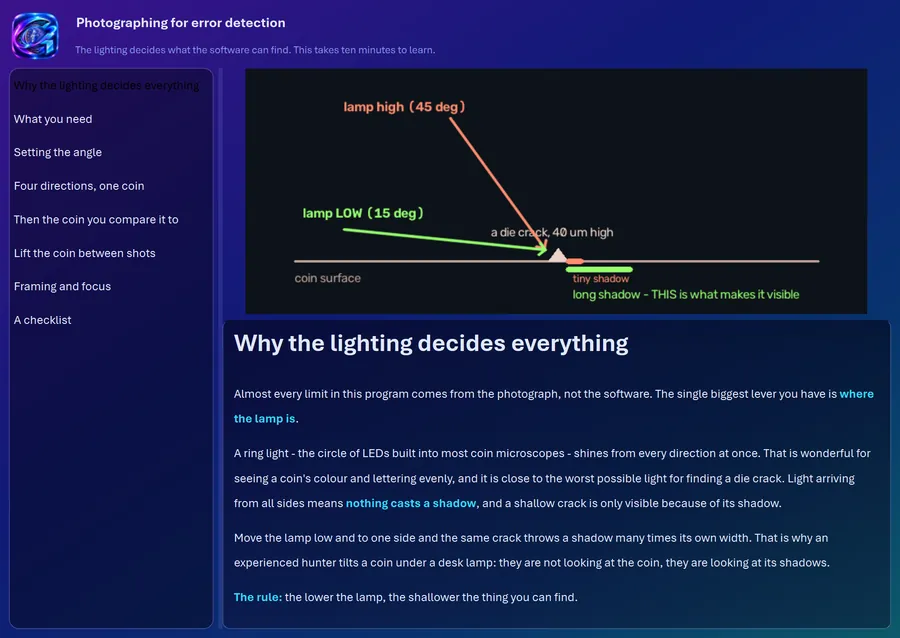
The same photograph, rendered fifteen different ways, because each one makes a different fault obvious. Raking light swings a virtual lamp around the coin, and a line that is raised throws its shadow the opposite way to one that is incuse - swing the lamp and the answer flips. Relief exaggerates height. Contour map draws lines of equal brightness, the way a walking map draws hills, so doubling shows up as a second contour running parallel at a constant distance while a crack cuts across them instead.
Micro detail, crack scan, edges, flow direction, heat map, depth map, negative, solarize, polarize and mono each isolate something else. Every view applies to the live feed and to saved photographs alike, and each one carries its own controls with a legend saying what the colours mean.

Doubled dies
Two independent tests run, because doubling presents in two completely different ways. Lighter classes leave a separated ghost standing off the primary image, and that test measures the gap. Heavy hub doubling - the 1955 cent among them - leaves no gap at all, because the two images have merged into one fat letter with notched corners, so a second test looks for a secondary wall running along the device outline instead. The verdict goes to whichever test actually fires.
A repeat-edge screen looks separately for doubling that recurs around the coin at a regular spacing, and the strike signature tool maps the direction metal flowed under the die.


Die studies
Asking whether one letter looks doubled is a local question, and local questions are how machine doubling gets mistaken for a variety. These tools ask a whole-coin question instead.
The displacement field measures how the secondary image moves across the entire coin and classifies the doubling from the shape of that movement - rotated, offset, pivoted - because each class of hub doubling moves in its own characteristic way. Hub registration fits one rigid transform to the whole coin and then tests whether it predicts parts of the coin it was never fitted on, which is the difference between a real relationship and a curve fitted to noise.
Die consensus turns the problem around entirely. A coin is one impression of a die, and the die is what carries the variety - so given several coins from the same die it recovers the die itself, which is sharper than any one worn specimen. The die-state tracker then orders coins from that die early to late by how the cracks and wear grow.


Doubled die, or machine doubling?
This is the question that decides whether a coin is worth a fortune or worth a cent, and it cannot be settled by arguing over flat-lit photographs. A doubled die was doubled in the die, so the secondary image is STRUCK - it stands at full height with its own rounded relief. Machine doubling happened as the die bounced on the way out, so it is a shelf: flat, shallow, shaved off the edge of the device.
The test measures relief across the suspect edge rather than looking at it. A struck secondary image has height; a shelf does not. The answer comes with the profile it was read from, so you can see the evidence rather than take the word for it.

Lines, cracks and hairlines
Whether a line adds value or destroys it depends entirely on whether the die put it there. Raised lines were struck into the coin: a die crack wanders irregularly and grows through a die's life, a die gouge is straighter and heavier, and die polish is many fine parallel lines running mostly one way across the fields. Incuse lines were cut into the coin afterwards, and that is damage.
The whole-coin finder traces thin lines across an entire face and calls each one raised or incuse. The microscopic finder is for high magnification, where the surface fills the frame, and it separates die polish and metal flow from the lustre grain they hide in.

Cleaning and lustre
A cleaned coin is worth a fraction of an original one, and telling the two apart is one of the things collectors most want help with. A coin that has been wiped, brushed or polished carries fine scratches running in roughly ONE direction, because a hand moves in one direction. That single fact is what the cleaning scan measures - and it is also why the scan is careful about die polish, which is also directional and is not damage at all.
Lustre is measured as a field rather than a brightness. Scoring lustre from one photograph only ever measures how much of the coin is bright, which a polished coin wins. Turning the coin, or the lamp, and watching how the highlight MOVES is what separates mint lustre from a whizzed surface.


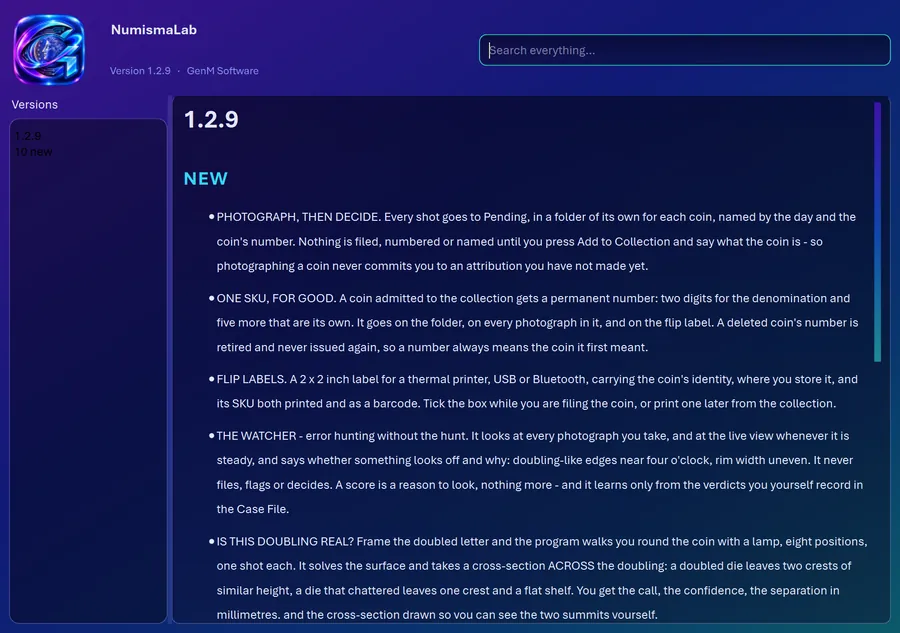
The Watcher and anomaly detection
The limiting factor in error hunting is attention, not magnification. The Watcher looks at every still, and at the live view whenever the picture is steady, and answers one question - is there something off about this coin? - as a score with the reasons behind it. It deliberately does not name the error. Naming is your job; its job is to stop you walking past something.
Anomaly detection runs several independent detectors and merges them into one ranked list. Surface analysis sorts every finding on the single bit that actually matters: does it sit above the field or below it - struck in, or done to the coin afterwards. The full coin survey covers every area of the coin rather than a handful of chosen zones, because hand-picked zones can only ever find what somebody thought to look for.
The vision check asks a different question again: not "is this different from a reference" but "is this the strangest place on this coin", judged against coins known to be right.

Measurement and calibration
Calibrate once and the on-screen caliper reads in millimetres and microns. Three ways to do it: against a coin whose diameter you know, by dragging along a steel rule or a stage micrometer, or by storing a scale for each magnification setting of your scope so it is ready next time.
"The doubling is 0.05 mm across" is only a fact if somebody else, on another scope, can measure 0.05 mm too. Until the scope is calibrated every distance is in pixels, and a pixel is a property of your camera rather than of the coin. The caliper behaves like the instrument it imitates - jaws that slide, a beam that shows the span, and a zero button.
Diameter can then be checked against the specification database, and the surface survey compares what is on the coin against what the design predicts, flagging what does not belong.


Comparing coins
Alignment Lab lines two or more photographs up to sub-pixel accuracy inside a region you choose, refining in stages - features and RANSAC for the rough rotation and scale, then sub-pixel correlation - so nothing about the match is guessed.
Pixelwise comparison across several shots of one side shows where the specimens agree and where they disagree: one-off damage stands out against what every coin from that die shares. Precision Compare goes further by removing the things that masquerade as differences - lighting change, sub-pixel misregistration, sensor noise - before reporting anything, because otherwise a comparison mostly measures your lamp.
Grading assistance
Wear is scored as the share of the raised design that has gone flat, relief as how much original height survives, lustre as the fraction of the surface throwing a specular highlight, and contact marks per unit area weighted so a mark on the open field counts for more than one hidden in the hair.
Every number is printed beside the range the Sheldon scale expects for it, so you can see which diagnostics agree with the estimate and which pull against it. That disagreement is the useful part: if wear says XF while lustre says Fine, something is odd about the coin or the lighting.
A counterfeit and alteration screen checks diameter against specification and scores field porosity, and the die-state tracker orders coins from one die early to late by how cracks and wear grow.


Three dimensions
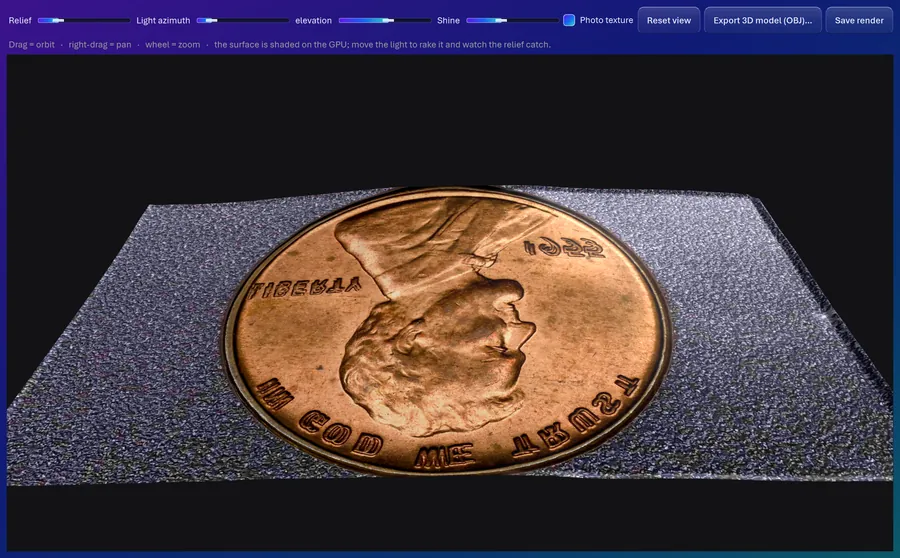
Photograph the same view five to fifteen times while turning the focus knob from one extreme to the other, and depth is measured from which frame is sharpest at each point. Capture a photometric light set, moving the lamp between shots, and the relief is computed from the shading - that is a real measurement. The result is a surface you can orbit, pan, zoom and relight on the graphics card, and export as an OBJ for Blender, MeshLab or the Windows 3D viewer.
Multi-light analysis is the same idea turned to a harder question: photograph one coin under several lamp positions and real topography can be separated from flat surface texture, because substance and shadow behave differently when the light moves.
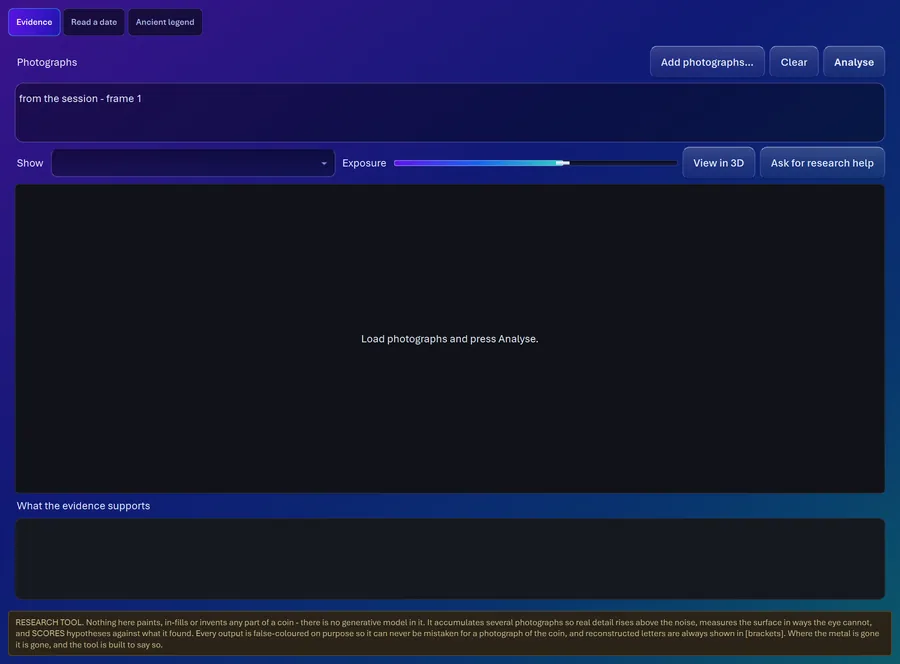
Reconstructing a worn design
A heavily worn coin loses its tonal contrast long before it loses its shape. Wear flattens the design and polishes the field to a similar brightness, so an ordinary photograph shows almost nothing while the metal still carries the geometry. Reconstruction works from that surviving shape rather than from brightness, and combines several photographs to bring a design back far enough to read.

Coin fingerprinting
Every coin carries marks that belong to that one specimen and no other - the particular constellation of contact marks and the exact edges of its own wear. Measured and stored, they recognise the same coin again years later, in someone else's photograph, after it has been slabbed, sold and photographed by three other people.
It answers questions a catalogue number cannot: is this the coin I sold, is this the coin in the old auction plate, is the coin that came back from grading the coin that went in.
Identification and the catalogue
Behind the naming boxes sits a specification database covering North American coinage from the colonial issues to the present - diameters, compositions, designers, mintages and key-date standing - together with the Wexler and CONECA error and variety taxonomy, and the named sub-types each series was actually struck in.
The text reader is a dedicated attempt at the hardest kind of OCR there is. Ordinary text recognition assumes ink on paper: dark, flat, evenly lit. A date on a coin is none of those - it is raised metal, read only by the shadow it throws, on a curved surface, often worn.
Every coin gets a permanent identifier, assigned once at random and never recalculated from its appearance. That is the decision everything else rests on: an identity computed from how a coin looks would change the moment the coin was cleaned, re-photographed or worn.

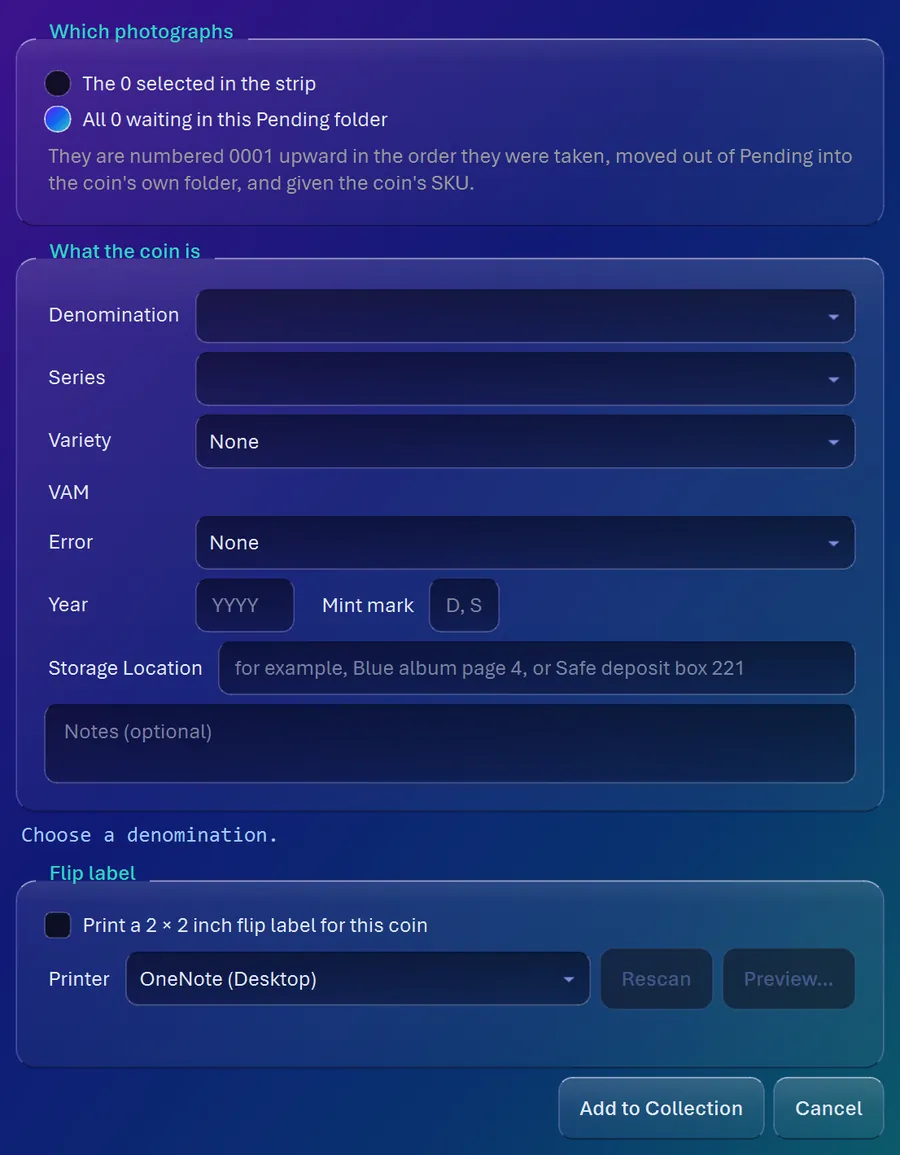
VAM attribution
The full Van Allen-Mallis catalogue: for every date and mint, the VAM designations, the short diagnostic titles that define them, and which collector lists each belongs to - Top 100, Hot 50, Hit List.
Three columns in the order somebody actually works: pick the date, pick the VAM, read what to look for. The right-hand pane is the point of it - the diagnostic markers written out one at a time, each saying WHERE on the coin to look, so you can work through them against your own photographs rather than trying to match a picture.
Ancient coins
A United States coin tells you its date. A Roman one does not - it tells you who struck it and what offices he held, and the date is deduced from that. TR P IIII COS II is a date if you can read it.
Identification therefore works from a partial legend: enter what survives, with gaps for what does not, and work towards the issues that fit.
Roll searching
Fifty cents in a roll, two sides each, and perhaps one of them deserves a second look. Shooting is not the bottleneck - looking properly at a hundred faces is. So you shoot fast and let the Watcher triage, stopping only on the frames that scored worth stopping on.
Your collection
A record per coin holding its photographs, year, denomination, series, variety, grade, what you paid, what it is worth now, provenance, your own notes, the physical shelf or box it actually sits in, and a SKU that never changes.
Photographs taken before you have identified a coin wait in a Pending folder, one folder per coin, and nothing is filed or given a SKU until you say what it is. Close the program part way through a coin and it comes back to that same coin next time. Any coin already filed can be put back on the bench so every tool can work on its photographs again.

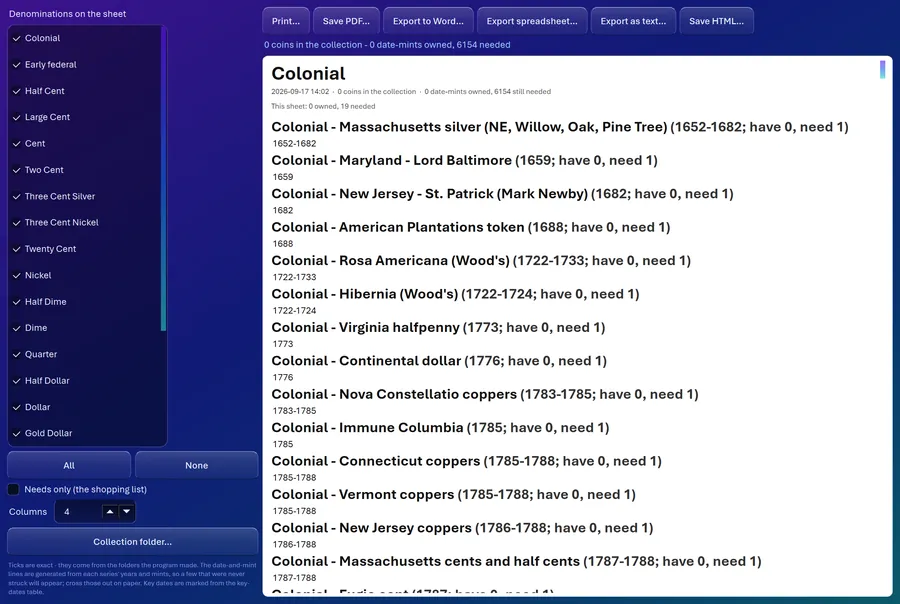
Inventory and the wish list
A printable sheet for a pocket at a coin show: for every series you collect, every date and mint mark that was struck, ticked where you already have one and blank where you do not.
The wish list is the reference Atlas made searchable and cross-referenced rather than shown as a page in a box - filter by what you hold, by what you want, by series or by list.
Collection statistics
Total value and cost, distribution by denomination, series, mint, grade band and decade, year span, variety counts, how many distinct types you hold, acquisitions and sales over time, and growth. Printable, or out as HTML or PDF for insurance.

Reports, listings and evidence
Everything measured about one coin, in one document: identity, mintage and key-date standing, the photographs with the lighting each was taken under, the measured relief across any doubling, the variety markers checked off one at a time.
"I think it is a VAM-4" is an opinion; a sealed evidence packet is something you can hand to somebody else. The same material writes a sale listing and a grading submission, because what NumismaLab records about a coin is considerably better than what a coin normally gets described with, and until now all of it stopped at the edge of the program.
The collection exports five ways - CSV for another program, HTML for a family member or an insurer who will install nothing, Excel for the ledger a collector actually keeps, PDF, or a copy of the database itself.
Case files
Open a question about a coin, gather the photographs and measurements that bear on it, annotate what you are pointing at, and record the verdict - including when the verdict is "nothing". Annotations are drawn onto saved photographs as easily as onto the live view.

Saved sessions and backups
A session is more than its photographs: the coin, its notes, every camera and processing setting, the annotations, the calibration, the window layout and which photographs were selected. All of it saves into one file kept inside the coin's own folder, so reopening it puts you back exactly where you stood.
The database backs up on request, and your collection, photographs and reports live outside the program folder by design - so uninstalling, reinstalling or letting a licence lapse never puts your work at risk.

Flip cards
Design your own 2x2 flip inserts with your own graphics, any font on your machine, and whatever you like on each face - the coin's history on one side, your business details on the other. A whole page prints front and back with the two sides aligned, using your printer's own duplex setting, and a design can be saved against an individual coin.

Flip labels
A 2x2 flip label to a thermal printer over USB or Bluetooth, or to any ordinary printer. It carries the coin details, your own name or business name, the storage location, and the SKU as a scannable Code 128 barcode, so the shelf and the software always agree. You can tick a box to print one at the moment you file the coin.

Screenshots, recording and watermarking
Capture the whole program, the whole screen or a single window, as a still or as video with optional microphone audio - for a forum post, a video, or showing somebody what you are looking at.
Every screenshot and every recorded frame carries a small NumismaLab mark at half opacity in the bottom-left: big enough to recognise, small enough to leave the coin alone, because the point of the picture is the coin.
NumismaticsU
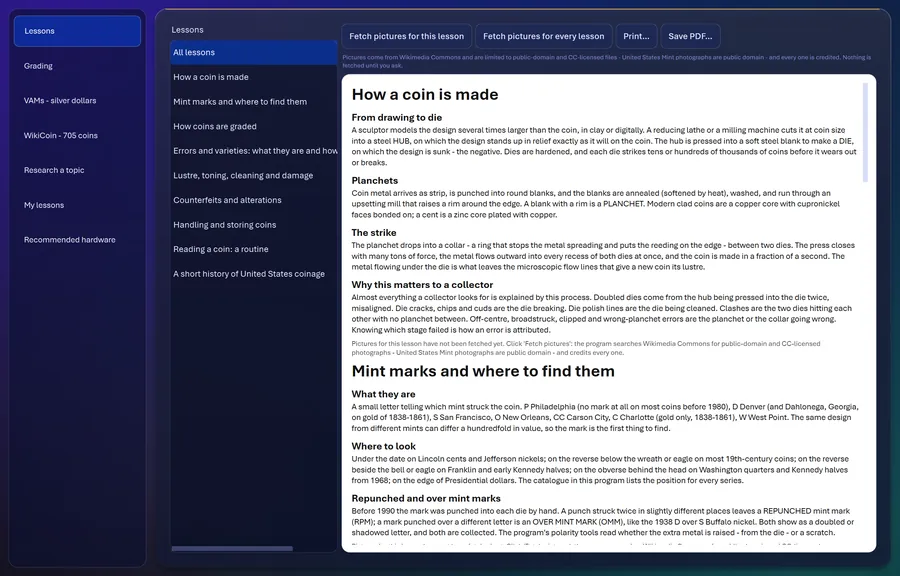
Everything you read rather than do, in its own window away from the scope: lessons on how coins are made, graded, marked, damaged, faked, stored and read, in plain words and with pictures.
With it come a full grading reference - the Sheldon scale, what a grader actually looks at, where each series wears first, and how the judgement shifts with the age of the coin - several hundred coins worth knowing and why, the confirmed VAM listings with their markers described, and a hardware guide for choosing a scope and a light.
The assistant panels
Claude, ChatGPT and Gemini run as signed-in web panels inside the program, using the subscriptions you already pay for. There is no API key to buy and no per-question charge, and the photographs and the question go across together so you are not describing a coin in words.
Answers come back into the coin's record rather than into a chat window you will close - kept on disk and in the database against that coin.

Experimental tools
Everything that infers rather than measures, gathered on one tab, coloured to mean caution, each with the specific reason it can be wrong written next to it. Monocular depth, the strangest-spot finder, the ping test, the watcher that scores a photograph for "worth a second look", and the text reader that tries to read a date off raised metal.
Before anything here analyses a well-framed coin it isolates the coin first, because half of a properly framed photograph is mat, and a mat under a microscope lamp is the strongest texture in the picture. Measured on a framed 1955 cent, leaving the mat in returned a contact-mark count of 96 against a scale whose worst band is 6.
The rest of it
A drawing toolbar down the side for marking up what you are looking at. Preset adjustments - a short list of named things to do to a picture - for anyone who does not want sixty-nine sliders. A reference photo library that searches Wikimedia Commons for public-domain Mint photographs and keeps chosen ones locally, downloading nothing without a click.
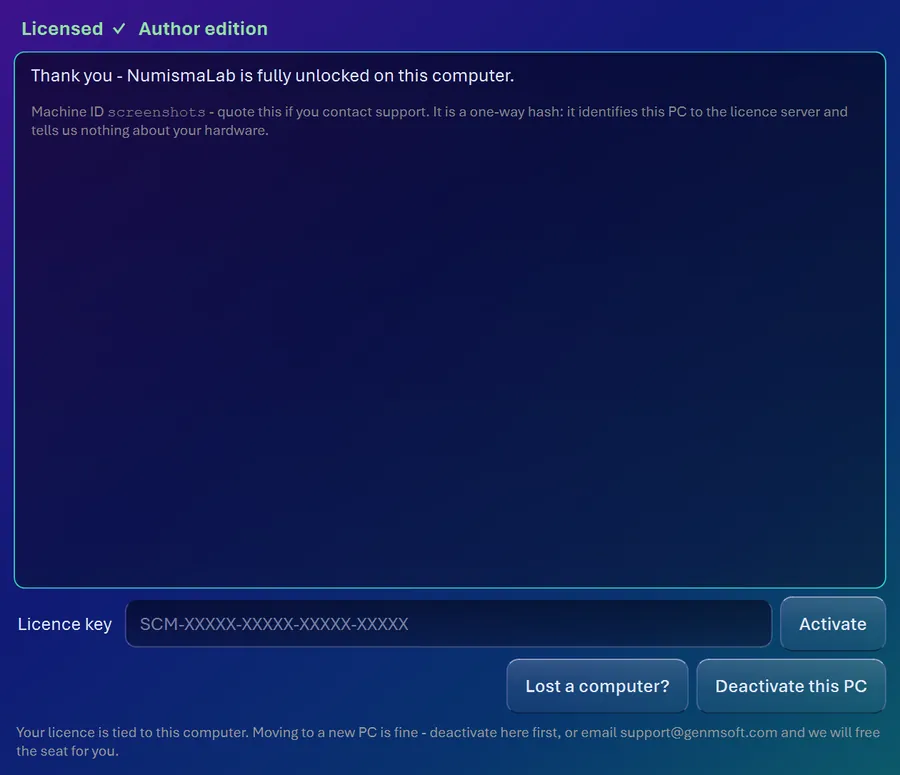
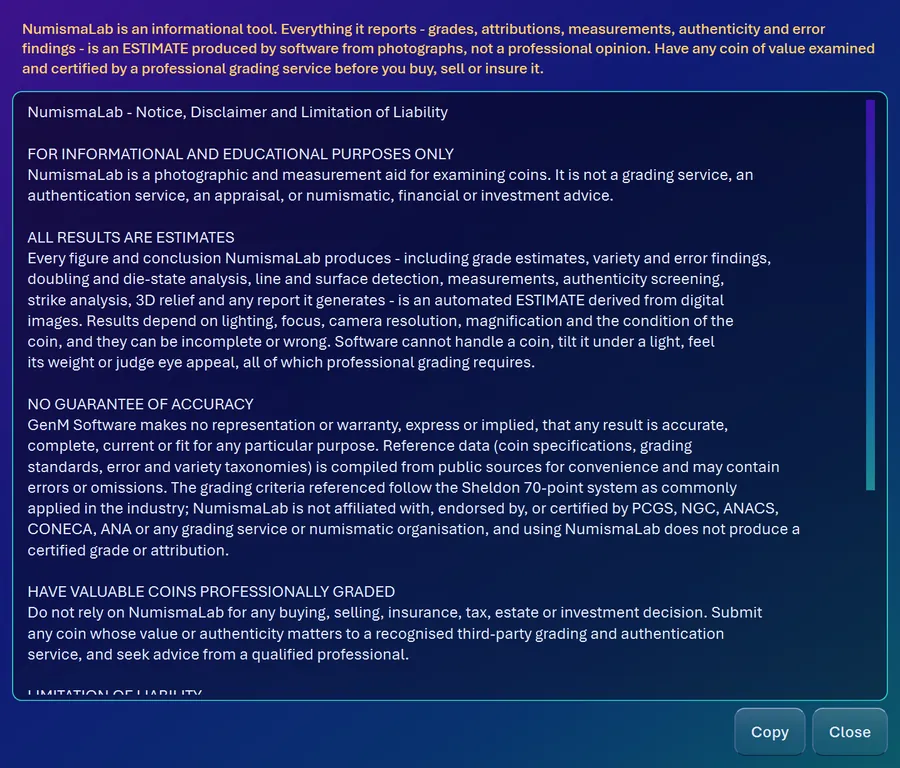
A feedback route that actually reaches me, release notes, the licence, the legal notice, and a requirements check that tells you where your own machine stands.

Not on sale yet
The trial and the licences arrive at launch. The invited beta is running now — places are limited and applying is not being chosen, but the form is open.
Request beta access